
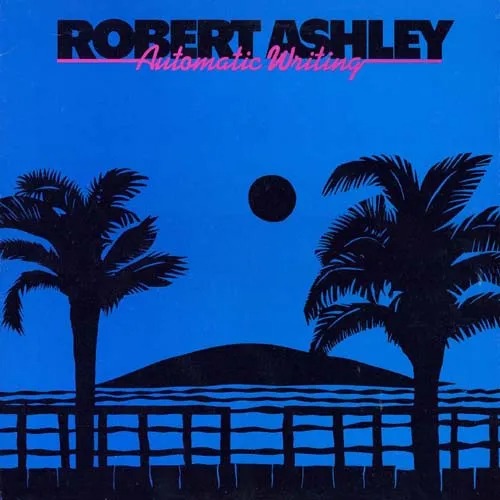
Robert Ashley - 'Automatic Writing' (1979)
If you are cisgendered and you'd like to understand how it feels to voice-train as a transgender woman, listen to Automatic Writing. To me, no other piece of art I've ever engaged with has captured the frustration, the doubt, the embarrassment, of the process like Ashley does here, the creator’s gender non-withstanding.
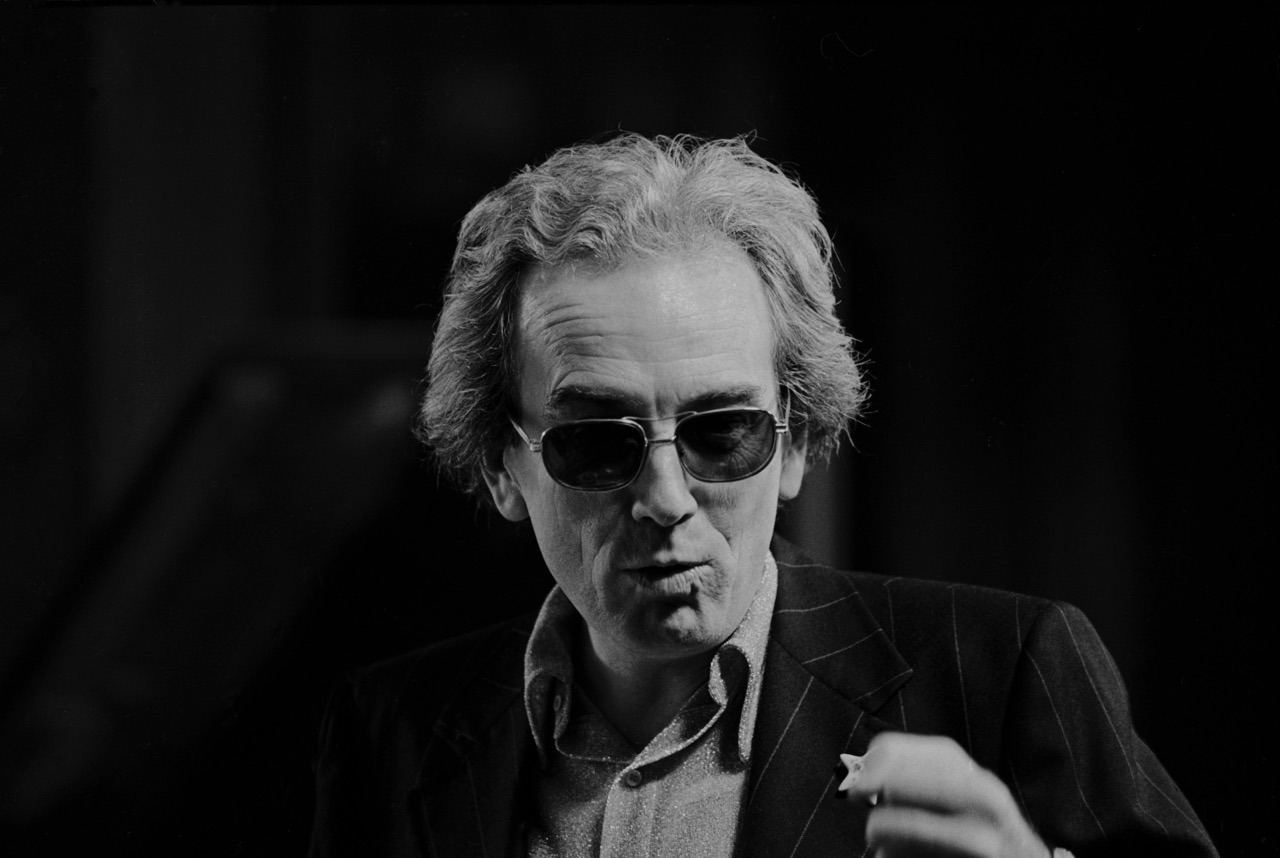
The opera of Automatic Writing is composed of four voices, two discordant and two harmonic. Comparing the two human voices reveals an immediate dichotomy. Mimi Johnson's whispered phrases possess an almost proto-ASMR quality; her tone is tender and intimate, full of soft sibilance and the gentle clicks and vowels of the already-romantic French language. Combined with her patient, steady delivery, one gets the impression that she is an actor in a speak-along vocab lesson. On the contrary, Robert Ashley's voice is not only masculine, but the ugliest kind of masculine. Even without the effects and editing over his vocalizations, the mic is placed far too close to his mouth, and every glutaral stop, swallowing of spit and unsteady whimper is captured in vivid, off-putting detail. Taken in conjunction with the distortion and panning, and Ashley is rendered almost monstrous; there are times where he sounds less like a man and more like a dying dog. His groans and laboured breaths smother the listener, the disquiet only soothed by Johnson's reassuring, almost maternal presence in the background.
That juxtaposition carries over to the musical backdrop of our opera. An organ drones away in the distance as if playing in the room next door, occasionally accompanied by a muffled groove drifting in and out of earshot. The foreground is dominated by this strange, cutting Polymoog patch, like glass bottles vibrating on the back of a milk truck. It is granular and alien, like something Autechre would build an NTS Sessions-era track around. The opera is split between an uncomfortable, too-close foreground and a beautiful, too-far backdrop: where you want to be, and where you’re stuck at.
The effect created in this repeated interplay that forms Automatic Writing is one of sustained effort and, more crucially, constant failure. Despite his many attempts, Ashley never fully crosses over back into comprehensibility, and you can never fully articulate the piece’s central lyrical motif — ‘my mind is censoring my own mind’, repeated dozens of times. You envision a person sitting alone in their room, desperately attempting to speak as clearly as the voice recorded onto tape. The sheer dissonance of his voice sounds less like a document of reality and more like an internal caricature, a dysphoric mind’s interpretation of the body untrained, testosterone-thickened vocal cords. The cruelty of that self-comparison is only intensified by Johnson’s voice; near-angelic in its femininity, her crystal clear words spoken in a language you do not understand. Everything beautiful in Automatic Writing occurs within sight, but out of grasp.
The speaker listens for a moment, then tries again: 'Heat from fire, fire from heat. Heat from fire, fire from heat. The vari-speed. The vari-speed.' She creeps up her pitch register and attempts to hold a tone, only for her body to fail on her yet again. The voice from her monitor chimes back in; forgiving and distant. With each repetition, the distance between the speaker and the teacher seems to grow - the speaker brushes her cheek and the stubble cuts a little more; her Adam's apple juts out a little further; the music grows a few decibels quieter. The speaker listens for a moment, then tries again.
Perhaps a more optimistic read of this dynamic is possible. Johnson reads her phrases with patience and empathy, like a good teacher dedicating time and effort to her student. The frustration of Automatic Writing never fully overwhelms the listener; Robert Ashley always knows when to pull back, when to apply the beautiful droning at the back of the mix like a balm. And despite the frustration, voice training is entirely possible for anyone and everyone, regardless of how deep and masculine you may sound today. It takes time, and effort, and perseverance, but you can cross over that barrier; join the recital in the room next door. In the words of a collaborator of Ashley's, next time might be your time.
But this is not how I'm left feeling when I listen to Automatic Writing. Listening to this is like being sent straight back into my 16 year old self, watching voice feminization tutorials alone in my room and hating every fucking bone in my hairy, overgrown body. With each repetition and exercise, I felt myself growing further and further away from the pristine femininity I was being promised. I was stuck in the most horrific of feedback loops, every failure distorting my mind's envisioning of my own voice; I couldn't tell you what I really sounded like when I spoke, only what I was scared of other people hearing. I'm ashamed to admit it, but I grew to resent the teacher at a certain point. Her glowing, post-FFS beauty was salt in the wound, proof that my failures were mine and mine alone. I am a far, far happier woman today; identifying as a butch, among other things, has allowed me to take some pride in the timbre and pitch of my voice, rather than viewing it as a curse. I do intend to return to voice training in 2026, mostly for the purposes of passing and public speaking, but I no longer view my failure to achieve a perfectly femme voice as proof of my insufficiency. But, for a brief moment after Automatic Writing ended, I was right back to where I started.
For me, this is where the real beauty of Ashley's work lies. For him to not only speak this openly about his condition, but build an entire composition around it, is honesty to the point of heroism. It makes something beautiful and tender out of the failure of a human body, a mind censoring itself. Though our reasons for struggle vary wildly, him and I share that experience of having braved the dissonance between the brain and the body; it is comforting to know that others were in the same spot. And, regardless of whether you view the arc of the piece as enduring perseverance or unending failure, Ashley treats himself (and, by extension, anyone who sees themselves in him) with kindness and grace; as if to say, 'it may hurt now, but it will be worth it. One day, your door will open.'